
Originally published on Medium (in Haptical), March 2017.
What Changes When Your UI Has Depth: 7 VR Design Considerations
Notes from my first impressions of Google Cardboard, before Daydream: what changes about interface design when your UI has depth.
When your interface has depth, the rules of 2D design change. These are seven things I noticed on VR and visual interface, from my time with Google Cardboard when it first came out. (This reflects the VR landscape of early 2017: HTC, Oculus and Magic Leap were heating things up.)
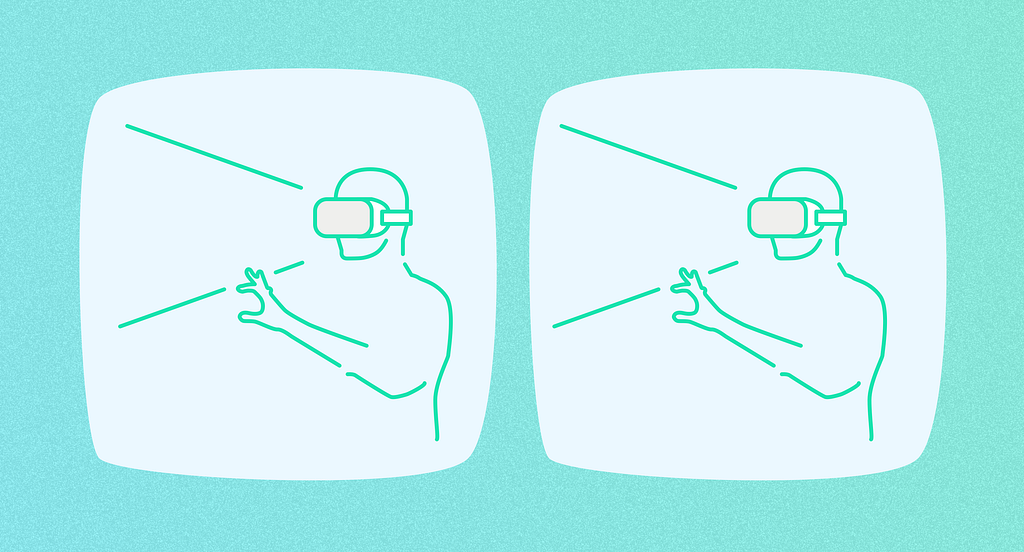
1. Depth of field reduces visual noise
Viewing an interface in stereo lets you show more content with less penalty from noise.
Typical UI design happens in 2D, where all content sits on a single plane and competes with its neighbor for attention. In 3D with stereo vision we get nearly infinite planes of depth, and the brain naturally reduces noise across the focal length. In VR, nearby objects interfere less, or not at all, when you're focused on something in the distance. That gives minimal interface design a lot of power.
In VR, nearby objects interfere less, or not at all, when you're focused on something in the distance.
Flat screenshots of VR scenes show how big the gap is.
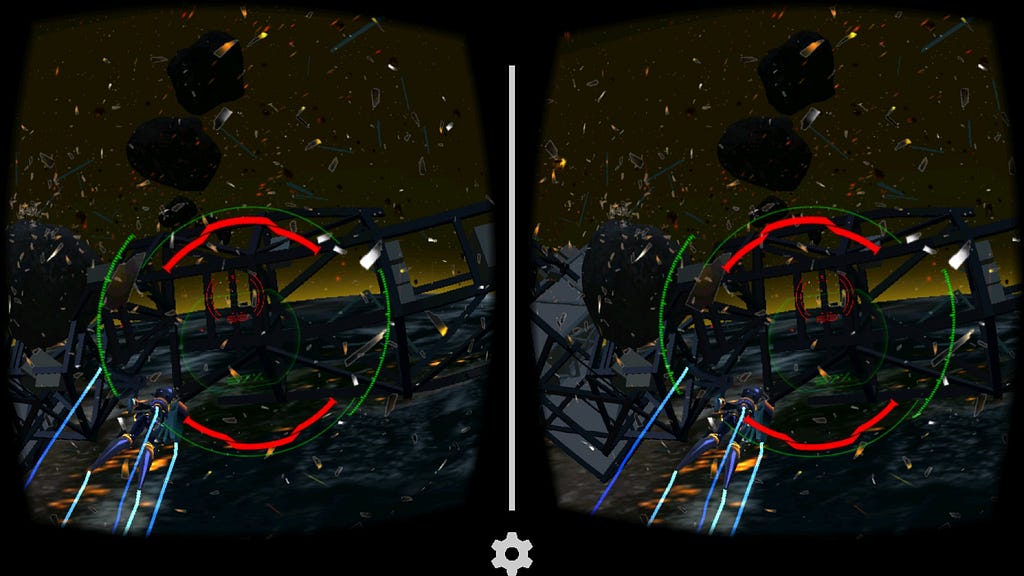
In a busy space shooter like the one above, the scene is almost indiscernible in 2D and looks overwhelmed by noise. In VR, with stereo vision, you have complete orientation and clarity as you move forward and dodge obstacles, and all that detail complements your focus instead of fighting it.
2. Change of focus takes work
Change of focus takes work, and that's both a caution and a new tool. Looking at UI elements in the distance and then shifting focus to nearby objects takes effort. That's something to be careful with, and also a new tool. We can use it to:
- create constraints toward goals
- stash additional controls and options
- use progressive disclosure for information or controls
- clean the working surface
3. The user is going to miss things
Place guidance in the user's path, like real-life signage. Because users will probably overlook a notification or guiding message, it's tempting to build interfaces that scream for attention from every angle. In real life, signage is placed in relevant spaces, in a person's path or line of sight. The same can apply in VR. Giving up super powers in the virtual space may produce an experience that feels more relatable, and so more immersive.
Giving up super powers in the virtual space may produce an experience that feels more relatable, and so more immersive.
4. Reality now has layers
Putting on a headset means entering a new perception with its own rules and norms. It doesn't need to stop there. It's easy to add more landscapes with new rules and norms, which I call layers, and those layers could go on indefinitely.
The transitions between layers
The transitions between layers are especially interesting. They can be harmonious, or they can add contrast or disruption. In my Figure 1 (layers of reality), the non-triangular shape shows that, with current technology, there is only one degradation of senses, in the jump from real life to layer 2. Later jumps typically don't lose any senses.
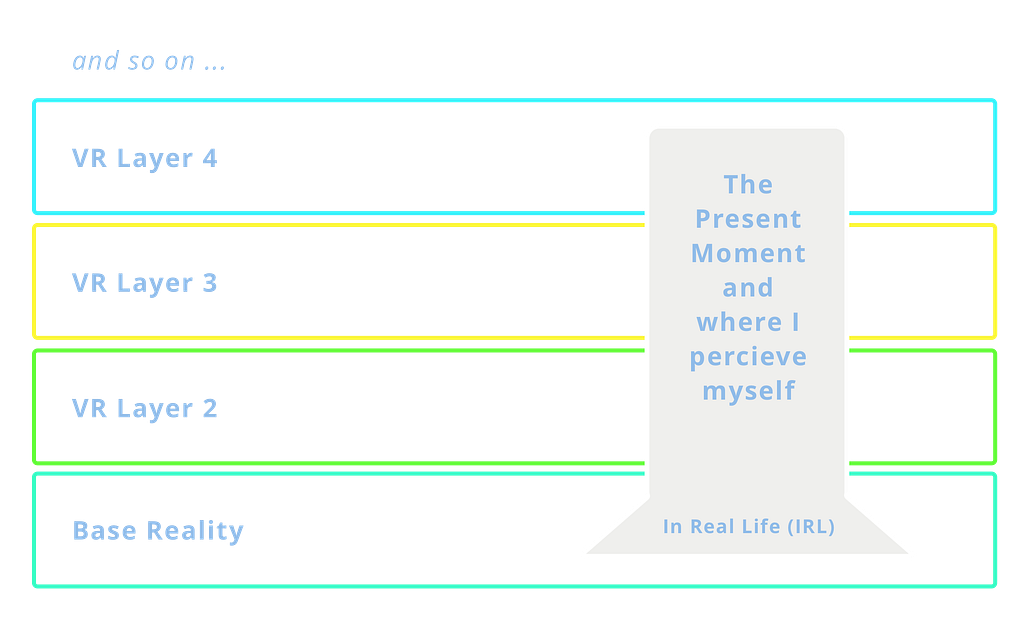
For example:
- Layer 2: a cinematic landscape.
- Layer 3: an animated environment, introduced on the path from layer 2.
- Transition: more like a gradient than an instant change.
5. You control which elements play nice with the environment
With VR we can finally break the laws of physics. Some of the most bizarre and intriguing VR experiences may be those where everything is normal except one thing. A novel "break" is a valuable tool for disrupting flow and calling attention where it's needed, and for making engagement more intriguing.
6. Design for the fact that you'll actually be there
You aren't looking at these environments and interfaces. You're surrounded by them. The industry calls this "presence." I think it's at the core of everything in VR. It will be interesting to see how presence shows up in augmented (AR) and mixed reality (MR), because as long as a user feels present, their experience is more real than any other.
As long as a user feels present, their experience is more real than any other.
7. The mental model has a new ego
This one is about the user, not the screen. Eastern philosophy and modern science both suggest that at the core of our being we are witnesses to the reality around us, and that the thoughts and memories in our head are just some of the things we witness. Ego, on the other hand, is the story we are living out. It feels real, maybe because owning it is one of the few things we know for sure.
Now we will witness experiences so immersive that the best of them can replace our own. Will that make us feel like a different person? If our mental model changes, won't we behave differently with the choices and interfaces in front of us?
Today I'd... (present-day commentary, not part of the 2017 article)
Today I'd treat spatial interfaces as a design-system problem: define depth tiers, focus distances and transition rules as reusable patterns, then user-test them in headset with real people early, since a flat mock-up misses most of what matters. I'd use AI-assisted tools to speed up scene variations and test scripts, and keep presence and comfort as the quality bar.
Next: spatial patterns need the same discipline as any system. For how I think about that, see Product thinking; for a related take on the visual side, read Why Great UIs Run on Grey.